
20
May

In Paris, my day begins with a baguette. Yes, I eat an entire baguette. I’m hungry!
Lunch varies, depending on whether I am traveling on the metro, sightseeing or just furiously writing in the sun; it could just be a bar of chocolate.
The evening meal is typically Congolese: smoked fish slowly cooked outside on a grill, Pondu (or Kaleji in Tshiluba), which is basically cassava leaves cooked in tomato sauce, roasted caterpillars, etc. The meal would not be complete, however, without fufu.
What is fufu? you ask.
It is hot dough, made with hot water and a variety of flour. In Paris, my cousin Mbuyi makes fufu with semolina flour. Other people make fufu with cassava flour, plantain flour or even potato flour.





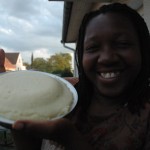
Fufu is your carb, your starch. It is the base of the meal; the vegetables and the meat or fish are there to accompany fufu (not the other way around).
If you ask any Luba elders, including my Dad who lives in Montreal… “have you eaten?”
They will tell you, “Today I have not eaten,” if they did not eat fufu that day.
Yours truly here must admit that, although fufu is an acquired taste, you sure can get hooked on it. Fufu is life.

My cousins are entering information in the family tree
I have started creating my family tree using the Ancestry app for iPad. This has facilitated my work tremendously as I travel and interview family members from one country to the next.
The iPad is gold. I am able to travel light. No need for a laptop. And I can even forgo bringing my heavy paper notebook if I desire. I can do everything with just my iPad.
Using the Ancestry app on my iPad, I have been able to add on information directly onto my family tree during an interview.
Sometimes, such as during my recent trip to Bruxelles, my cousins did the data entry themselves. This allowed me to sit back and socialize while the genealogy work was getting done. After all I was reuniting with this side of the family for the first time in 24 years. That was a blessing.
I like the fact that the genealogy application on my iPad is linked to the Ancestry website whenever I have connection to the internet. This means the family tree gets updated online; and so I can easily share it with all my family members instantly.
Here is what I don’t like (nothing can be perfect):
1. I need to have wifi connection to edit the family tree. Without internet, my family tree can just be a show-off piece like a mere hard copy book. I don’t think the Ancestry app will work too well in the Congo. Most houses do not have wifi connection. So how am I going to use the app and continue building my family tree as I travel from village to village? I wish there was a way to edit one’s family tree on the iPad without wifi. If anyone knows how, please let me know.
2. The second item I don’t like is that I need to enter manually every single person. What if I find entire other family trees that can be linked to my own? We’re talking about large African families. I don’t want to have to copy large family trees manually. There must be an easier way. Any thought on that? Your comments will be very much appreciated.
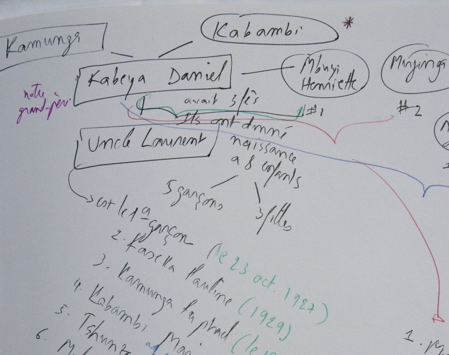
Drawing my family tree
“The practice of genealogy does not require any diploma and so anyone can do it. It only requires patience, discipline and method.”
That’s what I read in a French booklet on Genealogy.
I’m sure the people who wrote this were only talking Western genealogy. In doing my family tree, I realized that maybe there ought to be an African genealogy certificate. Such genealogy requires superpower patience, which I don’t have much in reserve. A good example is the case of “Multiple Wives.”
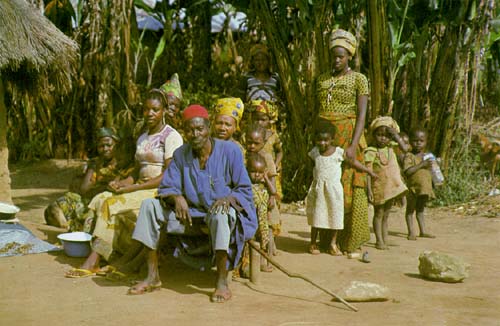
A Polygamous family (from http://emeagwali.com)
My people are called Baluba. We are the Luba people. Muluba is what I am; mu- is singular, ba- plural. We are known to be proud, hard working, confident, stubborn and very much disliked by the Belgian colonizers who could not quite control us.
But when it comes to genealogy, the most important characteristic of the Baluba is that Baluba men are polygamous; they love to have several wives and even more children. I have a cousin-in-law, whose father has 45 wives (not children, wives! I haven’t started adding them to our family tree yet. I hope the software won’t crash).
We are proud of our large families, except when it comes to creating a genealogy tree.
“Our grand-father had 12 children. He was a strong Muluba,” the interviewee says with pride and laughter. Our grand-father had three different wives. I quickly jot down the kids who belong to which wife. Later on, as I enter the information on my iPad, a cousin sits down next to me and says I shouldn’t enter the name of the different wives.
“Why not?” I ask, surprised.
“Because that will separate the family,” my cousin replies.
“Separate the family?!”
Here is the issue, she explains. Our grand-mother was the first wife and so the most important one and maybe her children as a result have more “social family status.” By listing the children of the two other wives separately seems, in my cousin’s opinion, to divide the children in three factions.
But then what would be the point of doing a family tree? Since men boast of having several wives, it’s public knowledge. Everyone knows it; my writing it down won’t make any difference.
Now to avoid hurting anyone’s feeling (such as writing down their real mother’s name), I am supposed to go and ask permission to every second wife’s kid, third wife’s kid, and so on, to write their mother’s name down in the family tree.
That’s insane!
If people in the family are ashamed of their mother, they should declare themselves orphan or something. I am not going to write down a fake mother’s name instead.
16
May

My cousins Kabeya and Mbuyi, both pastors.
In Paris, I have been hanging out with pastors. Both of my cousins are pastors; They’re actually cool. We spend hours together talking about the Torah; It’s the only part of the bible we have in common (me being Jewish, them being Protestants). We diverge widely when it comes to the Jesus question, but we’re still family.
However outside of family, Jesus becomes a sore point. I went with my cousin Kabeya to visit one of his friends and colleagues, a pastor friend. As we sat down for tea in the pastor’s house in a banlieue of Paris, my cousin announced that I was Jewish. Right away, I knew my being Jewish was not going to be good news; since earlier, the pastor friend had berated non-observant Christians, saying they were the cause of hell on earth.
The energy in the room shifted. I suddenly became the representative Jew and was asked every single question about Judaism.
“What do you Jews think of Abraham?”
I kept telling him to go and ask a rabbi; after all I could not speak for the entire Jewish population. As I dragged myself through the insufferable conversation, the inevitable question about Jesus was asked.
“So for you, Jesus was just a prophet …?”
“Not even,” I replied bluntly. By then I was simply fed up. “He was just another Jewish guy who happened to be very learned.”
That did not sit well with the audience. Yes, the pastor’s wife was also present by now; she was as fervent as her husband. My cousin, he remained quiet.
Eternal Life
Then the pastor said, “Let me ask you something…” He paused and continued slowly, “Do you have eternal life?”
I froze. His question brought me back in time.
I was bicycling across the midwest. It was summer time. I stopped by a church in a very small town and asked to pitch my tent in the backyard. When I saw the pastor, my jaw dropped. The pastor was, I kid you not, the most beautiful man I have ever seen in my life. He generously offered me the church lawn as well as a huge basket of fruits and vegetables. Not only was he handsome, but kind too. I could have married him on the spot.
But then, the gorgeous pastor asked me, “Are you saved?”
All my romantic dreams came crashing down. Any lust I had towards the man disappeared.
Here I am in France more than a decade later, facing the same type of question.
“Do you have eternal life?” I don’t even know what that means! But if it has something to do with Jesus, I don’t want it. I am very happy being Jewish.
Location: Saintry-Sur-Seine, France
(a banlieue of Paris).
I got here by bus from London on Wednesday, April 6th. The journey took more than 8 hours, but it was a beautiful road trip complete with the awesome cliffs of Dover at the edge of England.

On the Ferry

Cliffs of Dover
In a banlieue of Paris, I am now interviewing and filming my uncle Laurent. He is the patriarch of the family and knows our entire genealogy tree as well as our traditional Luba customs.
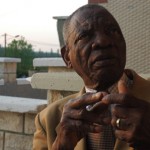
Uncle Laurent
I am getting educated about my own family: “What?! My great-grand father was a chief?” I have family members from Canada all the way down to Australia. Some of the people have died; others have emerged out of thin air… It seems that I have more siblings than I was aware of.
I learned that we, the Luba people, are one of the largest societies in the Congo. The reason is simple: men can marry several wives. The number of women a man has shows how wealthy he is. It is quite common to find wealthy Luba men to have even 45 children. Now I understand my aunt Rose, who tried to play matchmaker for me and proposed that I marry a certain Congolese man: “he only has 2 children,” she said.
This trip is already full of surprises… and I haven’t even landed in Congo yet.
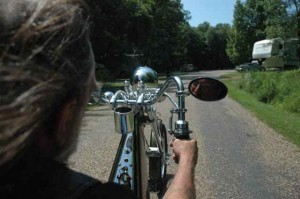
Speeding on the Highway

Off Loading

1920s Pick-up Trike
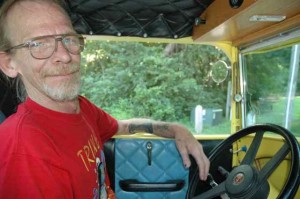
The Yellow Trike Man

The yellow trike
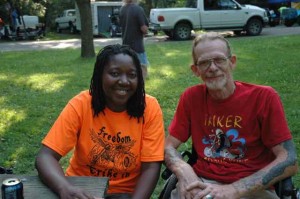
Having the time of my life, hanging out with trikers
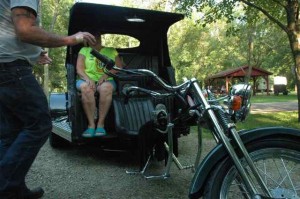
Trike Mania!
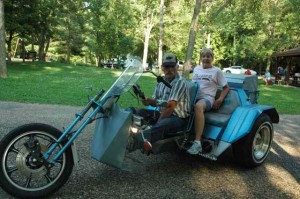
Trikers are for families

Getting geared up for a trike ride after a dinner of hot dog and burgers.
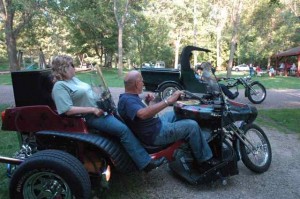
Heading out to the Trike games
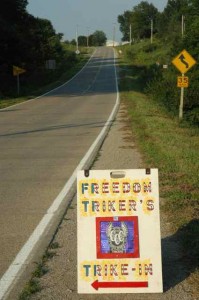
Freedom Trikers, right here in Fairfield, Iowa!
The story of my day hanging out with the trikers is coming soon…
22
Jul

My first day in Iowa, I saw this sticker on a truck. I quickly learned that Iowa is part of the bible belt.
I grew up with 7 dogs and 3 cats. People in the Congo said my household was weird. The kitten loved to suck milk from the female dog’s breasts. And our Dalmatian-looking dog was best friend with a monkey.
With all my experience with pets, Americans thought I had enough credentials to take care of their dogs. And so throughout college, I earned a good portion of my living dog-sitting.
On my first assignment, I had to take the dog out for a walk. Never having done so (the dogs back home roamed around freely), I didn’t have any plastic bag with me. I was totally unprepared when the dog stopped on the sidewalk and pooped. I went to a nearby Pizza Hut and asked for a plastic bag. They gave me a handful. But how do I scoop the manure? I didn’t know. I ended up using all the plastic bags to finally get the job done.
All was well until the dog decided to poop a second time…
My African friends in the U.S. always cracked up laughing when I had to leave a party early to take a dog out. I must have been the only African they knew who had such a job.
Later on, I got promoted. I took care of two dogs at the same time. A family was traveling abroad, so I housesat and took care of their portuguese water dogs for a week. I got a call from the owner. She was calling long-distance from the Middle East, sitting at a restaurant with her husband and her two youngest children.
“How are my babies?” she asked me.
“What?” I was startled. “I thought they were with you.” I thought to myself, weren’t her children traveling with her?
“No, I mean my babies. How are they?” she repeated.
“You mean, your DOGS?” I finally understood.
This new way of looking at animals like one’s own children baffles me. My African friends have a feast about it and often ask me: “Who are you babysitting now? A human baby or a dog?”
“Animals are wonderful, because they put you in a great emotional state,” said James Ray, an American philosopher in the book, The Secret. “When you feel love for your pet, that great state of love will bring goodness into your life. And what a gift that is.”
I get that! I understand the love that one has for another creature, but do people in the West sometimes go too far?
A few years ago, the Canadian government sent back 150 Chinese refugees who tried to dock their boat in British Columbia. Canada sent back everyone, except one refugee _ a dog, for which offers of adoption poured in.
In Chicago, I saw lots of adoption signs on the train. Tons of them! But none of them were about adopting a human baby.
Isn’t this madness?
3
Jul

I was looking at a neat and useful blog, http://www.peaceloveandhappiness.org/?q=node/356 and run accross this painting. It was painted by a chimpanzee named Congo. The ape lived in a British zoo and painted. How interesting! This reminded me of a gorilla back home named Marcel, who lived in a zoo in Kinshasa. He smoked cigarettes. Not as interesting as painting, but to a child, a smoking gorilla was fascinating.